 Neatkept
How to label moving boxes so you can find anything after the move
Moving day is close and the boxes are piling up. A few minutes of labelling per box decides whether you find the kettle tonight or next month.
Updated
Why most box labels fail
The usual label is "KITCHEN" in marker on the lid. It tells the movers where to carry the box and nothing else. Three weeks later, with twelve kitchen boxes stacked in a corner, you open them one by one to find the grater. Lids also get stacked under other boxes, so a label on top is the one nobody can see.
A good system answers three questions without opening anything: which room the box goes to, which box this is, and what is roughly inside. The first is for moving day. The other two are for the weeks after.
A system that works: number, room, keywords
Give every box three things, written large with a thick marker:
- A number. Count up from 1 across the whole move, not per room. A number never repeats, so "box 37" is one box. If you have more than one destination, add a letter: H37 for the house, S12 for the storeroom.
- A room. The room in the new home, not the old one. "Kids' room", not "Anna's things", because the movers don't know Anna.
- Two to five keywords. "Pans, grater, baking tins." Enough to tell this kitchen box from the other eleven.
Write all of it on two opposite sides, not only on the lid. Boxes get stacked, and a side is what you see. Add the number on the lid as well, since that is what you see when you look down into a pile.
Keep one master list
The box tells you where it goes. The list tells you what is in it. Every time you close a box, write its number and its full contents on one list: a notebook, a spreadsheet or a notes app on your phone. Keep it with you, not packed.
When you need something after the move, you search the list, read the number, and walk to that box. This is the step people skip, and it is the one that saves the most time. A photo of the open box before you tape it shut is even quicker than writing, and it settles arguments about what went where.
If several people pack, give each a block of numbers: 1 to 99 for one, 100 to 199 for another. Nobody writes the same number twice, and everyone still adds to the same list, or sends a photo of their page at the end of each day.
Before you start: a packing checklist
Set this up once, and every box after that takes a minute to label:
- A thick marker for each person packing, plus a spare
- Room names agreed in advance, and a coloured sticker or tape for each room if you use colours
- A numbering plan: one sequence for the whole move, with a letter per destination if there are several
- The master list started, with a column for the number, the room and the contents
- An "open first" box per person: chargers, medicines, documents, toiletries, a kettle, bedding for the first night
- "Fragile" and "this side up" marked on the boxes that need it, on the sides, not only the lid
- A sign on each door in the new home with the room name and colour, so movers don't have to ask
On moving day and after
Number the boxes as you load them, not as you unload, so nothing is unaccounted for. If someone helps you unload, ask them to put every box in its room, even if the room is crowded. A box in the right room is half unpacked.
Then unpack by need, not by order. The list tells you which box holds the thing you need today. Boxes you won't open for a while, like books or seasonal clothes, can go straight into storage. They keep their numbers and their place on the list, so they stay findable for months. Cross a box off the list once it is empty, and reuse its number only if you start a new list.
Doing it with Neatkept
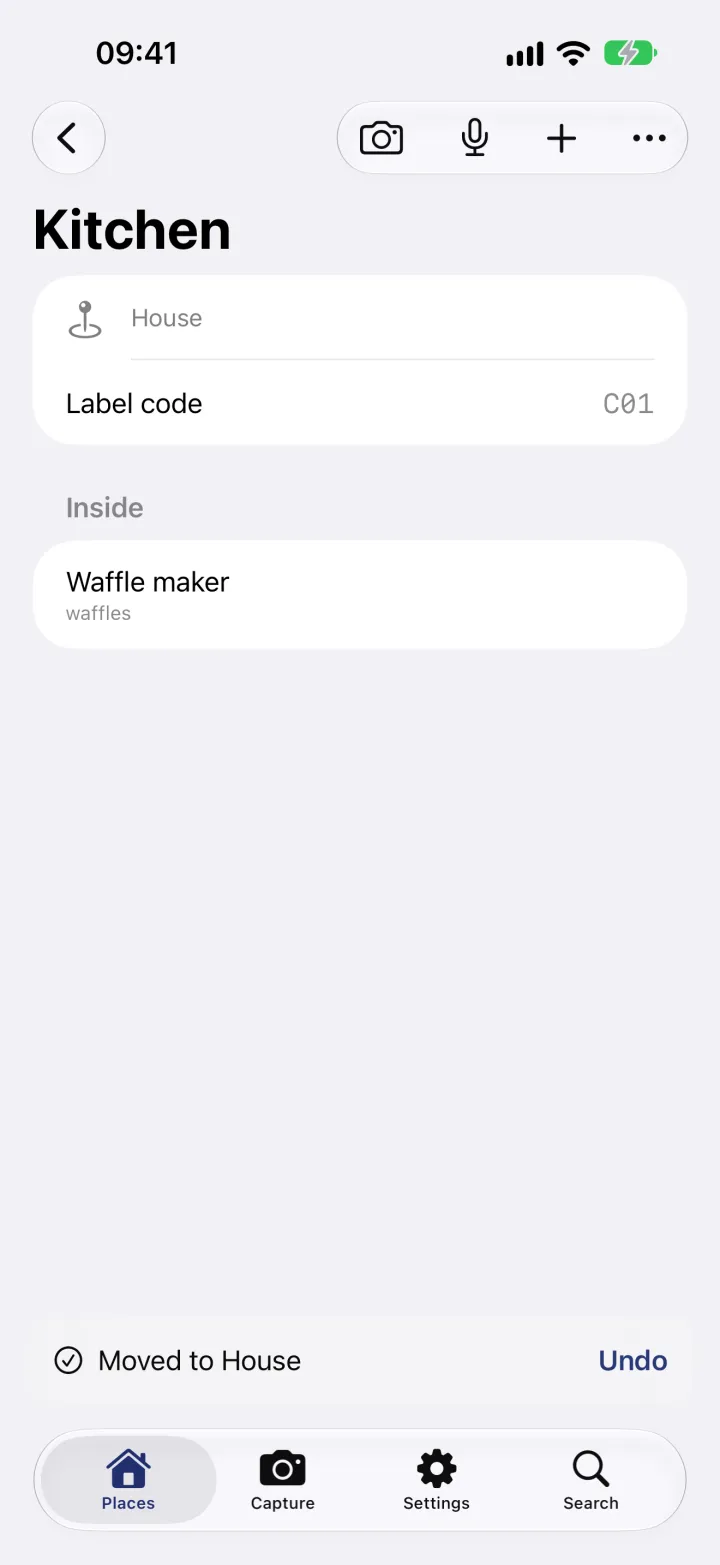
In Neatkept you write a short code like H37 on the box with a marker, or stick a printed QR label, and the code opens that box in the app. Before you tape a box shut, open Capture, choose Box and photograph the contents from above; Neatkept proposes a list of what it sees, and you keep or drop each thing. At the new home, open the box, tap ⋯ and choose Move the box, or scan the box's label and then the room's. Everything inside goes along, and search finds any of it across all your homes. The moving house page shows it step by step.
Questions and answers
Should I write the full contents on the box?
Write the room, the number and a few key words, not a full list. The box is read in a hallway by someone carrying it, so short and large wins. Keep the full list elsewhere, on paper or on your phone, under the box number.
Is it safe to write "laptop" or "jewellery" on a box?
Better not. Boxes stand in the street, in a van and in shared stairwells. For valuable things write only the number and the room, and keep what is inside on your own list. Carry the most valuable things yourself.
Colour stickers or written room names?
Both work, and they work best together. Colours are quick for movers to spot from a distance; the written room name is there for when the colour is unclear or the tape runs out. Put a matching colour on each room's door in the new home.
How many boxes does a typical move need?
It depends far more on how much you own than on the size of the home, so there is no reliable rule. Pack one room first, count the boxes, and use that to estimate the rest before you buy more.
Neatkept for this
Moving house
You're moving from the city flat to the house. Dozens of boxes, and you want to know which one has the waffle maker.
Unpack after moving
The move is done and the hallway is full of boxes you won't unpack this month. One photo per box, and you still know what's in each.
Boxes labelled with a marker
No printer, no stickers, just a marker. You write K01 on the box of kids' toys and still find out what's inside without opening it.
Labels and box codes
A QR label or a code written with a marker. Either one opens the box in Neatkept.
Moves
Tell Neatkept where a box or a thing went, and its place is right for everyone in your household.
Capture from a photo
Photograph an open box or a shelf. Neatkept lists what it sees, and you decide what to keep.