 Neatkept
How to keep an inventory of a self-storage unit you rarely visit
You rent a storage unit across town and go there twice a year. Every time, you open five boxes to find the one you came for.
Updated
The problem with a unit you rarely see
A storage unit is out of sight and out of mind. You pack it in a hurry, close the door and come back months later. By then nobody remembers which box holds the camping stove, or whether the old laptop went there at all. A visit turns into an afternoon of lifting boxes, and sometimes the thing was at home the whole time.
The fix is not more effort on the day you visit. It is a little order on the day you pack, and a list you can read from your sofa. If the list is good, most trips to the unit become ten minutes: drive, open, take box 14, go home.
Map the unit before you fill it
Before the first box goes in, decide on a layout. Even a small unit has zones you can name:
- By the door for things you will want soon or often: seasonal gear, tools, the tent.
- Left wall and right wall for stacks of boxes, heavy ones at the bottom.
- Back for things you won't need for a year or more: furniture, archive boxes, a cot.
- An aisle down the middle, even a narrow one, so you can reach the back without unloading.
Write the zone names down and use them the same way every time. "Back left, top" is a place, just like a shelf at home. Take one photo from the door when the unit is full. That picture alone answers many questions later.
Number every box and write down what's inside
Give each box a short code that you can read from the aisle: a number, or a letter and a number like S14. Write it on two sides and on the top, large, so it's visible however the box is stacked. A printed label works as well as a marker.
Then, for each box, record:
- its code and its zone,
- what is in it, in words you would search for later,
- how many, where it matters (four tyres, six chairs),
- anything fragile or valuable inside,
- a photo of the open box before you tape it.
That photo is worth more than any description. When you can't remember whether the blue vase went to the unit, the photo settles it in a second. For furniture and large things that don't fit in a box, the zone and a photo are enough.
Keep the access details with the list
Storage units come with their own small facts: the unit number, the gate code, the padlock code or where the key is, the opening hours and the company's phone number. Keep them in the same place as the list, not on a sticky note in a drawer. When someone else in the family goes to fetch something, they need both the contents and the way in. Keep codes somewhere that is locked, not in a plain note others can read.
Make every visit update the list
The list only stays true if each visit leaves it true. Before you go, look up what you are fetching and where it is. At the unit, before you close the door:
- note what you took out and where it went,
- note what you brought in and which box and zone it went to,
- move boxes back to their zones, or change the zone on the list,
- take a new photo from the door if the layout changed.
Many units are in basements or behind thick walls with no phone signal, so pick a way of writing things down that works offline. Updating the list at the unit takes two minutes. Doing it later from memory rarely happens.
Once a year, or when the rent goes up, read the whole list. Things you haven't needed for two years are worth asking about: is it worth paying to store them?
Doing it with Neatkept
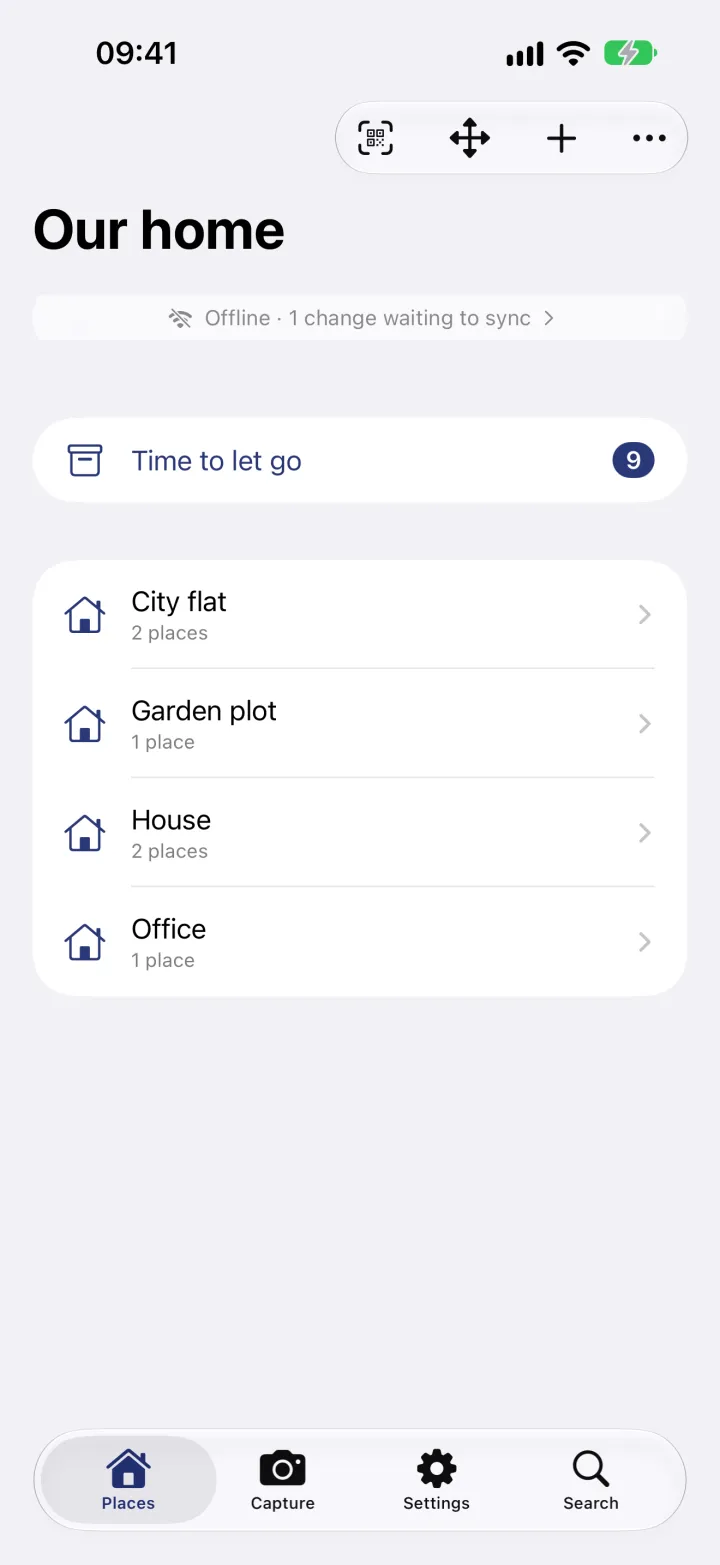
In Neatkept the storage unit is one more property in Places, next to your home. Add its zones as places, then your boxes, with a printed QR label from Print labels or a code you write with a marker. Photograph an open box and AI proposes what is in it; you keep or drop each thing. Search covers the unit and your home at once, so you see whether the camping stove is in box S14 before you drive there. Neatkept works with no signal, so you can move and add things at the unit and they sync once you're back online. The gate or padlock code can sit on the unit's place as an encrypted lock code that opens with Face ID or a fingerprint. The storeroom with no signal page shows the offline part step by step.
Questions and answers
Is it worth listing every single thing in a storage unit?
List every box and what is in it, at the level you would search for. "Winter tyres, 4", "kitchen plates, about 20" and "documents 2015–2020" are enough. You don't need each fork, but you do need to know which box has the plates.
Are my things in a storage unit insured?
It depends on your home contents policy and on the storage company. Some home policies cover things kept elsewhere up to a limit, some don't. Ask both before you move valuable things in, and keep a list with photos either way.
How do I find a box at the back without emptying the unit?
Plan for it when you pack. Leave a narrow aisle, put the boxes you will need first near the door, and give each box a number you can read from the aisle. With a list that says "box 14, back left, top", you go straight to it.
What should I not keep in a storage unit?
Food, anything flammable, and things that can't stand cold, damp or heat, unless the unit is climate controlled. The storage company's contract lists what it forbids. Keep passports, cash and the only copy of important papers at home.
Neatkept for this
Storeroom with no signal
The storeroom is in the basement, and your phone has no signal down there. You're sorting the boxes anyway.
Print labels for your boxes
You've bought a stack of storage boxes and want each one to say what's inside without opening it.
Find anything in seconds
Your child needs the skis on Saturday, and you have a flat, a house and a garage. Ask once and know where to drive.
The garden gate code
The gate at the garden plot has a code lock, and you open it twice a year. Every time, nobody remembers the code.
All your places
Every home you have, in one tree. Things sit in a box or right on a shelf, and each one has a full path.
Labels and box codes
A QR label or a code written with a marker. Either one opens the box in Neatkept.
Search in your own words
Ask the way you'd ask a person. Neatkept answers with the home, the room, the box and a photo.
Works offline
Basements, garages and garden plots often have no signal. Neatkept works there anyway and catches up later.
Lock codes
The garden gate, the storeroom door, the padlock on a crate. Neatkept keeps their codes, sealed.