 Neatkept
How to make a home inventory for insurance — a practical checklist
After a flood or a burglary, the insurer asks what you had and what it was worth. A list made now, with photos, turns weeks of remembering into an afternoon.
Updated
Why bother before anything happens
A claim after a fire, a flood or a burglary asks you to list what you lost. Standing in a wet room, few people can remember what was in the hall cupboard, let alone the brand of the drill or how many coats hung there. Things nobody lists are hard to claim for. An inventory made on an ordinary evening is calm, complete and cheap to keep up.
It also shows whether your cover is enough. Add up the values and compare the total with the contents sum on your policy. You may find you are insured for far less than you own, or for far more.
What to record for each thing
For most things, four facts are enough:
- What it is. "Cordless drill, Bosch", not "tool". The make and model matter for anything electronic.
- Where it is. The room and, for stored things, the box. It proves the thing was in that home.
- A photo. One photo of the thing, or of an open box showing several, is the strongest proof you can have.
- What it cost. What you paid or a fair guess, with the currency. Quantity counts: six chairs are six times one.
For valuable things, add the serial number, a photo of the receipt and any certificate (jewellery, art, bicycles). Those are the items an insurer is most likely to question.
Go room by room, then into the boxes
Start where the value is: living room, kitchen, bedrooms, office. Stand in the doorway and photograph each wall, then open cupboards and drawers. Large things are quick; spend your time on the small expensive ones, like headphones, cameras, tools and watches.
Then the places people forget: the storeroom, the garage, the attic, the cellar, the garden shed. Boxes there hold a surprising amount of value, from ski gear to the old laptop. Open each box, photograph its contents, and note what is in it. If you have more than one home, do each one separately, so a claim for one address lists only that address.
Keep it where you'll find it after the worst day
A list on paper in the house is lost with the house. Keep the inventory where it survives: in an app that syncs to a server, in cloud storage, or as a printed copy at a relative's. A PDF with photos is what an insurer can read straight away; a spreadsheet is handy for totals.
Keep it current without trying
An inventory goes stale the moment you buy something. The trick is to make adding a thing so quick that you do it when it arrives: one photo, a name, a place. Once a year, when the policy renews, open the list, add the values you skipped and compare the total with your cover.
Doing it with Neatkept
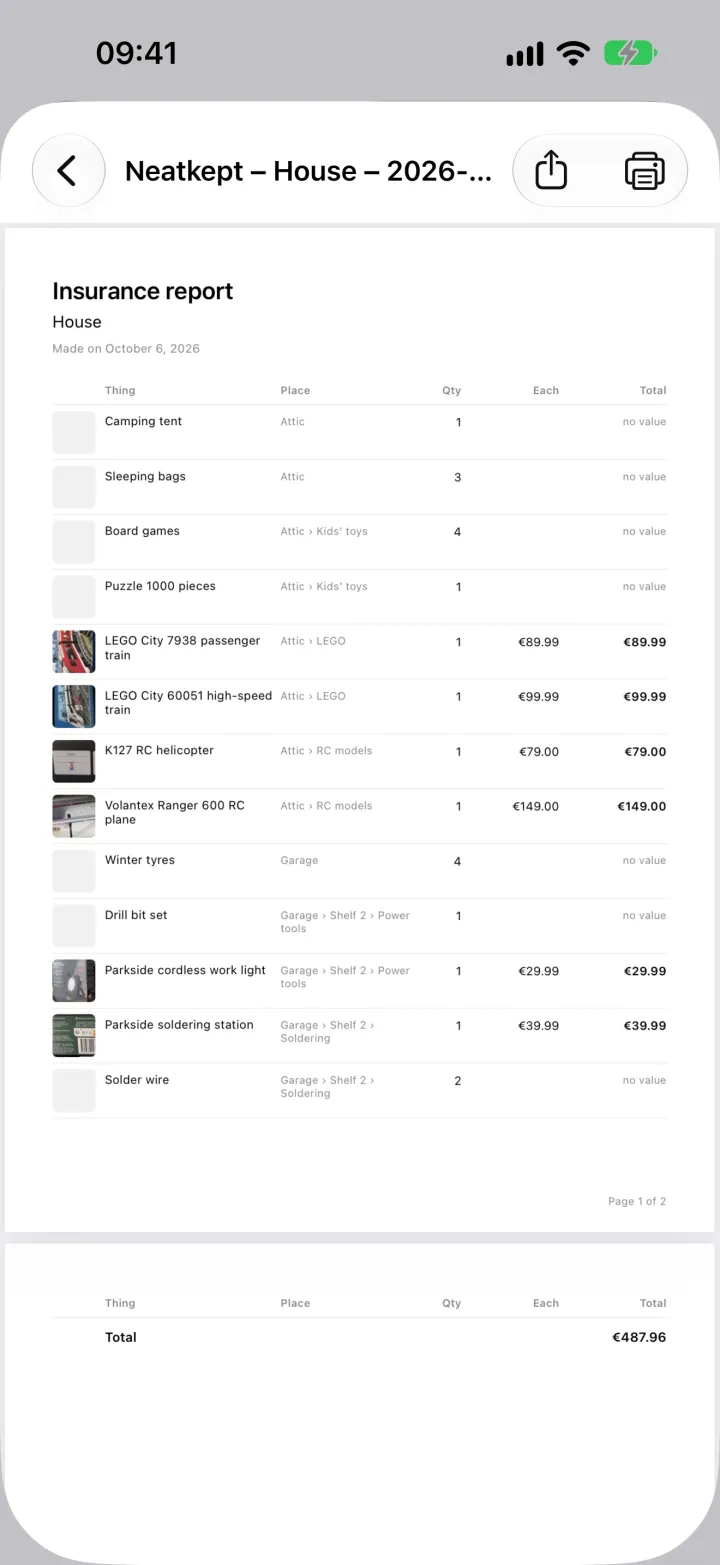
In Neatkept you photograph an open box or a shelf and AI proposes what is in it; you keep or drop each thing. Every thing sits in its place, from the property down to the box. When the insurer asks, open the property and choose Insurance report: every thing with its photo, place, quantity and value, things without a value first so you can fill them in, totals per currency, as an A4 PDF or a CSV. The insurance report page shows it step by step.
Questions and answers
Do I need receipts for everything?
No. Receipts help for expensive things, so photograph those and keep them with the item. For everyday things, a photo, a rough value and the year you bought it are what most claims start from. Your insurer's own claim form says what it accepts.
Should I use replacement value or what I paid?
Write down what you paid, or your best guess. Whether the claim pays the price of a new one or a used one depends on your policy, and the insurer works that out. A rough figure is far better than an empty field.
How often should I update it?
Whenever something valuable comes in or goes out, and a quick pass once a year, for example when the policy renews. If adding a thing takes a photo, the list stays current on its own.
Where should I keep the inventory?
Somewhere that survives the house: in the cloud, or a copy with someone you trust. A folder in the cupboard that burned is no help. Export a PDF or a spreadsheet now and then and store it away from home.
Neatkept for this
A list for the insurer
You're renewing the home insurance, and the insurer asks what's in the house and what it's worth. The list is already in your phone.
Unpack after moving
The move is done and the hallway is full of boxes you won't unpack this month. One photo per box, and you still know what's in each.
Insurance report
A list of everything in a home, with photos and values, ready for your insurer.
Capture from a photo
Photograph an open box or a shelf. Neatkept lists what it sees, and you decide what to keep.
All your places
Every home you have, in one tree. Things sit in a box or right on a shelf, and each one has a full path.