 Neatkept
How to declutter by a rule: keep or let go of what nobody touched in two years
The cupboards are full and you'd let some things go, but every single one feels like it might be needed. A rule decides faster than you can.
Updated
Why a rule works better than a feeling
Held in your hand, almost everything looks useful. You remember what it cost, you imagine the day you might need it, and back it goes. Decluttering by feeling is slow and tiring, so it rarely gets finished.
A rule takes the first decision out of your hands. "Nothing anyone has touched for two years" turns a cupboard of maybes into a short list. You still decide each thing, but only the ones the rule points at, and the question is no longer "could this be useful?" but "did we use it?". That one has an answer.
Choose your rule
A good rule is simple enough to say in one line. The common ones:
- Not touched for two years. The classic. Covers a full cycle of seasons, plus a spare one.
- Bought and never opened for a year. Things still in their packaging are the clearest case: if it hasn't been opened in a year, the need that bought it has probably passed.
- Owned for a long time. "Bought more than eight years ago" is not a reason to let go, but it is a good moment to ask whether it still works and whether you'd buy it again.
Apply one rule to one area at a time: the hall cupboard, then the storeroom, then the garage. A whole house at once is how decluttering stalls.
The exceptions, decided in advance
Every rule needs exceptions, and it is easier to decide them before you start than to argue each one:
- documents, warranties and anything you might be asked to show;
- emergency things: the first-aid kit, a torch, spare fuses, the camping stove for a power cut;
- spare parts and fixings for things you still own;
- things kept for someone else, like clothes for a younger child;
- a small, limited amount of sentiment: one box of keepsakes per person, not a storeroom.
If a category is on this list, the rule skips it. Everything else that the rule finds goes on the table.
Four answers for each thing
When the list is in front of you, give each thing one of four answers and move on:
- Keep, and check again in a year. You have a real plan for it. Write down the date.
- Keep for good. It's on the exceptions list after all, or you simply decided. Don't ask again.
- Let it go. Sell it, give it away, or recycle or throw it out. Decide which on the spot.
- Not mine to decide. Ask the person whose it is.
Put what goes into one box by the door, and note why each thing left. "Sold", "given to a friend", "thrown out" is enough. A year later, when someone asks where the old projector went, you'll know.
Make the next round easier
The hard part of a usage rule is knowing when things were last used. From now on, keep track:
- write the date on a box's label each time you open it for something;
- when you take a thing out and put it back, note that it was used, not just that it moved;
- keep what you use often in front, and let the back of the shelf show what doesn't move;
- run the rule once a year, at the same time, so it becomes a habit and not a project.
Doing it with Neatkept
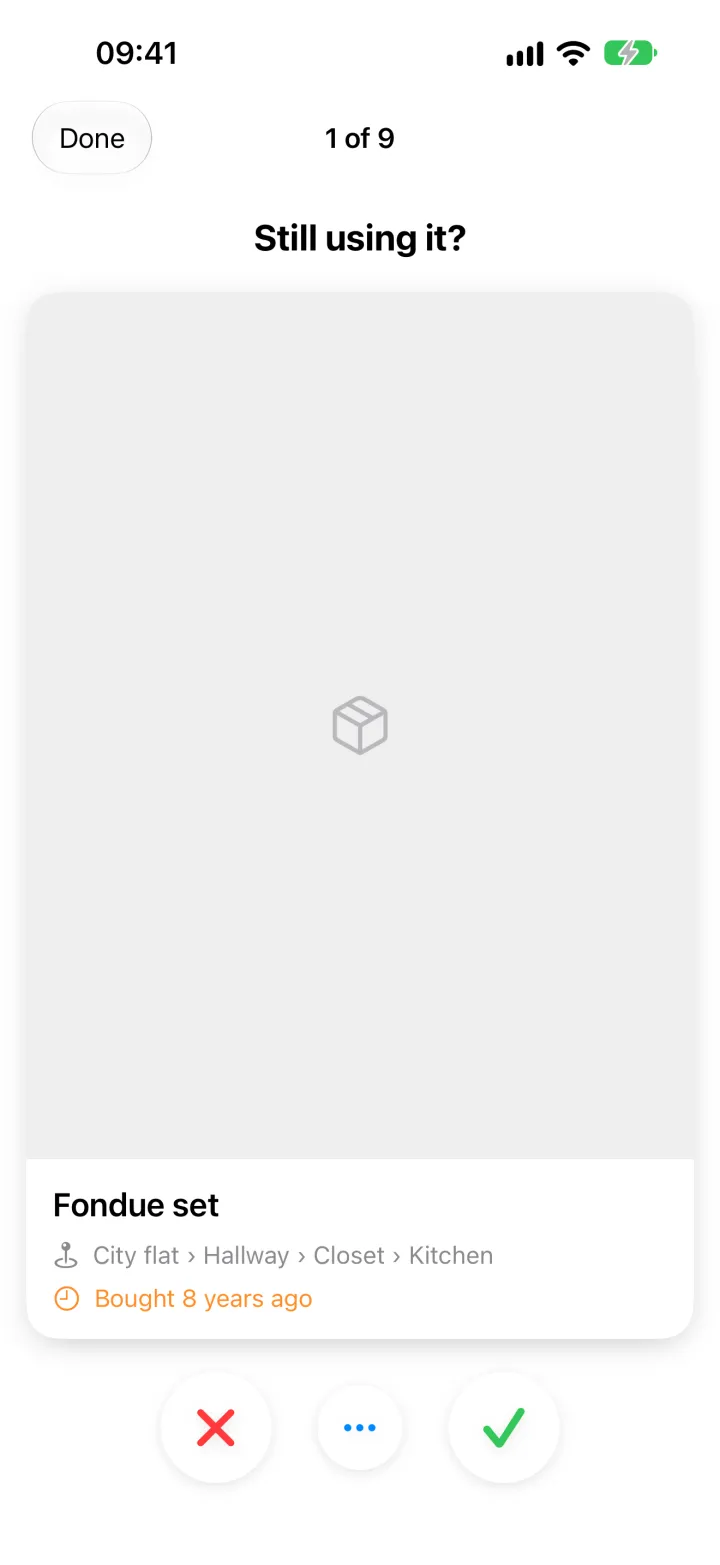
Neatkept keeps the rules for you. Every household starts with two: unopened for 12 months and not touched for 24, both skipping documents, and you can add your own under Declutter in your household's settings, for all places, one place or one box. When a rule finds something, Time to let go appears at the top of Places, grouped by home and place, with the reason next to each thing. Editing a thing, moving it on its own, taking it with you or opening it from search counts as a touch; moving the box it's in doesn't. Tap Review and answer "Still using it?": keep it for a year, keep it forever, or let it go with a reason and Undo. The declutter page shows how it works.
Questions and answers
Why two years and not one?
One year catches things you use every other season, like a tent or a holiday decoration that skipped a year. Two years is long enough that "I didn't use it" really means "I don't use it". Pick a shorter rule for clothes and a longer one for tools if that suits you.
What if I let something go and then need it?
It happens, and it is usually cheap: borrow it, rent it or buy a used one. Keep a short list of what you let go and how, so you know whether to look for it or not.
Should I ask the rest of the family first?
Yes, for anything shared or anything that is theirs. A rule tells you what is unused; it doesn't tell you whose it is. Let each person decide on their own things.
How do I know when a thing was last used?
Most of the time you don't, which is why people keep everything. Start noting it now: a date on a box when you open it, a coloured dot on a tag, or an app that records it for you. In a year you'll have real answers.
Neatkept for this
Declutter
The closets are full of things bought years ago. You'd let some of them go, if you knew which.
Do I have it already?
You're in a shop holding a LEGO train and can't remember whether the kids already have it. Or it's a gift, and you're putting it away.
Declutter
Set a rule like "not touched for 2 years", and Neatkept shows what's due. You decide, one card at a time.
All your places
Every home you have, in one tree. Things sit in a box or right on a shelf, and each one has a full path.
Search in your own words
Ask the way you'd ask a person. Neatkept answers with the home, the room, the box and a photo.