 Neatkept
How to organise a garage or storeroom and keep track of what's in it
The garage or the storeroom has become the place things go to be forgotten. You want to walk in, take what you need and walk out.
Updated
Start by emptying, not by buying
The urge is to buy shelves and boxes first. Don't. Until you know what you have, you don't know what to store it in. Pick a dry day, take everything out, or at least everything from one wall, and sort it into four piles: keep here, belongs somewhere else in the home, give away or sell, throw away.
Be honest about the keep pile. A garage fills up with things kept "just in case". If you can't remember when you last used it and could borrow or rebuy it cheaply, it is a candidate to go.
Divide the space into zones
A zone is an area for one kind of thing: garden, tools, car, sports, seasonal, long-term storage. Zones are what make a space findable. When you need the bike pump, you know which corner to walk to before you open a single box.
Place the zones by how often you use them:
- Near the door: what you take out weekly. Garden tools in season, bikes, shopping bags, the toolbox.
- Middle shelves, at eye and waist height: what you need every month or so.
- High shelves and the back: seasonal things and long-term storage, like holiday decorations, camping gear and keepsakes.
- Low and on the floor: heavy things only. Paint tins, bags of soil, spare tiles.
Keep a clear path to every zone. A shelf you can't reach without moving three boxes is a shelf nobody uses.
Mark each zone with a sign on the shelf edge or a strip of tape on the floor, and give it a plain name. Once a zone has a name, everyone in the household can use it: "it goes back in Sports" is an instruction anyone can follow.
Shelves, boxes and what goes where
Open shelving is the backbone of most garages and storerooms. Choose shelves deep enough for your boxes and sturdy enough for the heaviest of them, and fix tall units to the wall.
Then use boxes of the same size where you can. Same-size boxes stack, fit the shelves exactly and can swap places without a puzzle. Big loose things, like a lawnmower or a ladder, stay out of boxes and get their own spot, on the floor or on wall hooks.
Use this checklist when you set up:
- Shelves fixed to the wall, heavy things on the bottom
- Same-size lidded boxes, a few spares for later
- One kind of thing per box, not "misc"
- A label on every box and on every shelf or zone
- Hooks or a pegboard for long tools, hoses and bikes
- A clear walkway and nothing stored in front of the electrical panel or the water valve
- Chemicals and sharp tools out of children's reach
Keep a record of what's where
Labels tell you which box is which. A record tells you which box holds the thing you're looking for. It doesn't have to be detailed. For each box, the code, its shelf and the main things in it are enough. Write it down as you pack each box during the sort, not afterwards from memory.
Give places names that will still make sense in a year: "Garage, shelf 2", "Storeroom, back wall". If you have more than one storeroom, or a garage at a second home, name them so nobody confuses them. The record is only useful if it is somewhere you can open while standing in front of the shelf, and basements and garages often have no mobile signal. A phone app that works offline, or a printed copy taped inside the door, covers that.
Keep it working
A garage stays organised when putting things back is as easy as dropping them. Leave a little free space on each shelf for things that come in. Keep one "to sort" box near the door, and empty it every week or two.
When you take a tool somewhere else, a neighbour's or a second home, note it. Most "lost" things in a garage are things someone borrowed. Once a year, before the busy season, walk through the zones and move what is in the wrong one. It takes an hour, not a weekend.
Doing it with Neatkept
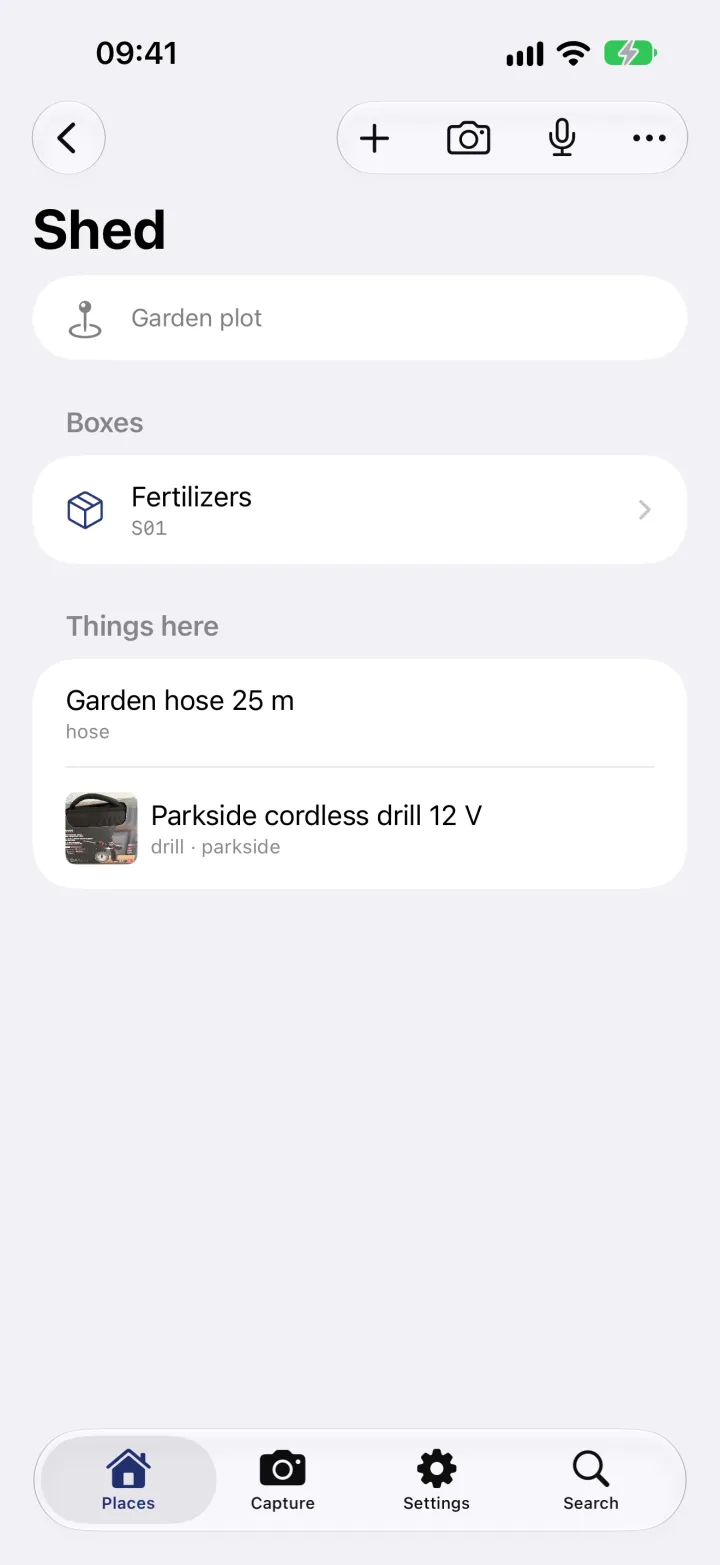
In Neatkept the garage or the storeroom is a place in Places, with its own zones, shelves and boxes inside, and a thing can sit in a box or right on a shelf. Boxes, shelves and zones can carry printed QR labels that open them from a scan with everything inside; a box can also carry a code written with a marker, which you type under the scanner. With no signal in the storeroom, search, scanning labels, adding and moving all still work; changes sync once you're online. Take a tool with you and Neatkept remembers where it came from until you put it down somewhere. The storeroom with no signal page shows how.
Questions and answers
Clear boxes or opaque ones?
Clear boxes let you see roughly what's inside, which helps with things you use often. Opaque boxes keep out light and look tidier, and with a good label you don't need to see in. Many people use clear ones at eye level and opaque ones higher up.
How do I keep things dry in a damp garage?
Keep boxes off the floor on shelves or pallets, leave a gap between boxes and the wall, and use plastic boxes with lids rather than cardboard. Cardboard soaks up moisture and invites pests. Check the corners after a wet season.
Where should chemicals and paint go?
Up high or in a lockable cabinet, out of reach of children and away from heat. Keep them in their original containers with the labels intact, and follow the storage advice printed on them.
How long does a full sort take?
For a crowded garage, plan a whole day, or a few evenings one zone at a time. Doing one zone completely is better than doing all of them halfway.
Neatkept for this
Storeroom with no signal
The storeroom is in the basement, and your phone has no signal down there. You're sorting the boxes anyway.
Tools to the garden
You need the drill at the garden plot this weekend. It lives in the house's garage, and next month someone will look for it there.
Print labels for your boxes
You've bought a stack of storage boxes and want each one to say what's inside without opening it.
All your places
Every home you have, in one tree. Things sit in a box or right on a shelf, and each one has a full path.
Labels and box codes
A QR label or a code written with a marker. Either one opens the box in Neatkept.
Works offline
Basements, garages and garden plots often have no signal. Neatkept works there anyway and catches up later.
With me
Take a thing along, and Neatkept knows it's with you. Later, put it back or put it where you are.