 Neatkept
How to organise a basement storage cage and know what's down there
The cage in the cellar holds a few years of boxes, and nobody remembers what is behind the first row. You want to go down once and come back up with the right thing.
Updated
Start with what is there
A cage is cheap space, and cheap space fills up. Before you buy a single shelf, take everything out into the corridor, or at least everything from one side, and sort it into four piles: keep in the cage, belongs upstairs, give away or sell, throw away.
Be honest about the last two. A box that moved with you twice and was never opened is telling you something. If you could not say what is in it, and nothing in it is a document or a keepsake, open it before you decide. If it turns out to be nothing you would miss, it can go.
While it is all in the corridor, wipe the floor and check the walls and the corners for damp. It is the one moment you can see the whole floor.
Use the height, not the floor
Most cages are small on the floor and tall in the air. Floor-to-ceiling shelving is what turns a cage into a room you can use, but plan it with care:
- Shelves deep enough for your boxes and strong enough for the heaviest one. Boxes should not stick out into the walkway.
- Heavy things low. Tins of paint, tools, tiles, books. Light and bulky things go up high: bedding, seasonal decorations, empty bags.
- Leave a walkway you can walk along without turning sideways, and keep the back reachable. A shelf you can only reach by moving three boxes is a shelf you stop using.
- Everything off the floor. Even a few centimetres is enough to save a box from a small leak.
Open metal shelving is usually better than a closed cupboard here. Air gets through it, and you can see where things are.
Boxes: the same size, one kind of thing
Use boxes of one or two sizes. They stack, they fit the shelves without gaps, and they can swap places without a puzzle. Choose lidded plastic for anything you want to keep, as cardboard is fine for a short stay and poor for years in a cellar.
Pack by kind, not by room or by date: "Camping", "Christmas", "Kids' clothes 2–3 years", "Spare bathroom fittings". A box labelled "misc" is the one you will end up emptying onto the floor. Do not fill a box to the top. Leave a hand's width, so you can add one more thing without starting a new box.
Things that don't fit a box, such as a ladder, a folded pushchair or a rolled rug, get their own spot along the wall, on hooks or standing in a corner.
Label so you can read it from the walkway
Write the label on the short end of the box, the side that faces you on the shelf, and make it large enough to read from a step away. Use the same pattern on every box: a short code, then the contents in a few words, for instance "S12: ski gear, goggles, helmets".
Put a sign on the shelf as well, such as "Left, shelf 2", so a box has an address and not only a name. Then "S12 is on the left, shelf 2" is something anyone in the household can follow.
Keep a record of what is down there
Labels tell you which box is which. A record tells you which box holds the thing you are looking for. It does not need to be detailed: for each box, its code, its shelf and the main things inside are enough. Write it as you pack each box, not afterwards from memory. A list in a notebook or a spreadsheet works. A photo of each open box, taken before you close the lid, works too, and takes moments.
Basements often have no mobile signal, so the record has to work with no connection. A printed copy taped inside the cage door, or an app that works offline, covers it.
Name the cage so it cannot be confused with other places: "Building A, cellar cage 14". If you also have a garage or another storeroom, give each its own name.
Keep it working
A cage stays in order when putting things back is as easy as dropping them. Leave one shelf, or half a shelf, empty for things that arrive. Keep one "to sort" box by the door and empty it every few weeks.
When you take something out for a season, note it. Most things that are "lost" in a storeroom have only been carried upstairs and never came back. Once a year, spend an hour walking through, put wrong boxes in the right place and decide about whatever stayed closed all year. The declutter by a rule guide helps with that last part.
Doing it with Neatkept
In Neatkept the cage is a place in Places, with its shelves and boxes inside, and a thing can sit in a box or right on a shelf. Photograph an open box or a shelf and AI proposes what it sees; you keep or drop each thing with a tap, and nothing reaches AI until you allow it. Boxes and shelves can carry printed QR labels that open them from a scan with everything inside; a box can also carry a code written with a marker, which you type under the scanner. With no signal in the cellar, search, scanning labels, adding and moving still work, and changes sync once you are online (photos wait until then). Later, "where are the kids' skis?" answers with the place, the box and a photo. The storeroom with no signal page shows how.
Questions and answers
How do I keep things dry in a basement cage?
Keep everything off the floor on shelves or pallets, leave a gap between boxes and the wall, and use plastic boxes with lids rather than cardboard. Cardboard soaks up damp and invites pests. After a wet season, look at the corners and the bottom shelf first.
Should I use clear or opaque boxes?
Clear boxes let you see the contents at a glance, which is handy in a dark cage. Opaque ones keep out light and look tidier, and with a good label you don't need to see in. Whichever you choose, label them: what you see through plastic is rarely enough to tell two boxes apart.
What should never go into a basement cage?
Anything that spoils or suffers from damp and cold: food, candles, electronics with batteries left in, photographs, paper documents, leather and good textiles. Check your building's rules too, as many forbid fuel, gas bottles and paint thinners in shared cellars.
How often should I go through the cage?
Once a year is enough if you put things away properly in between. Walk through it, move anything that has ended up in the wrong place, and decide about the boxes you did not open all year.
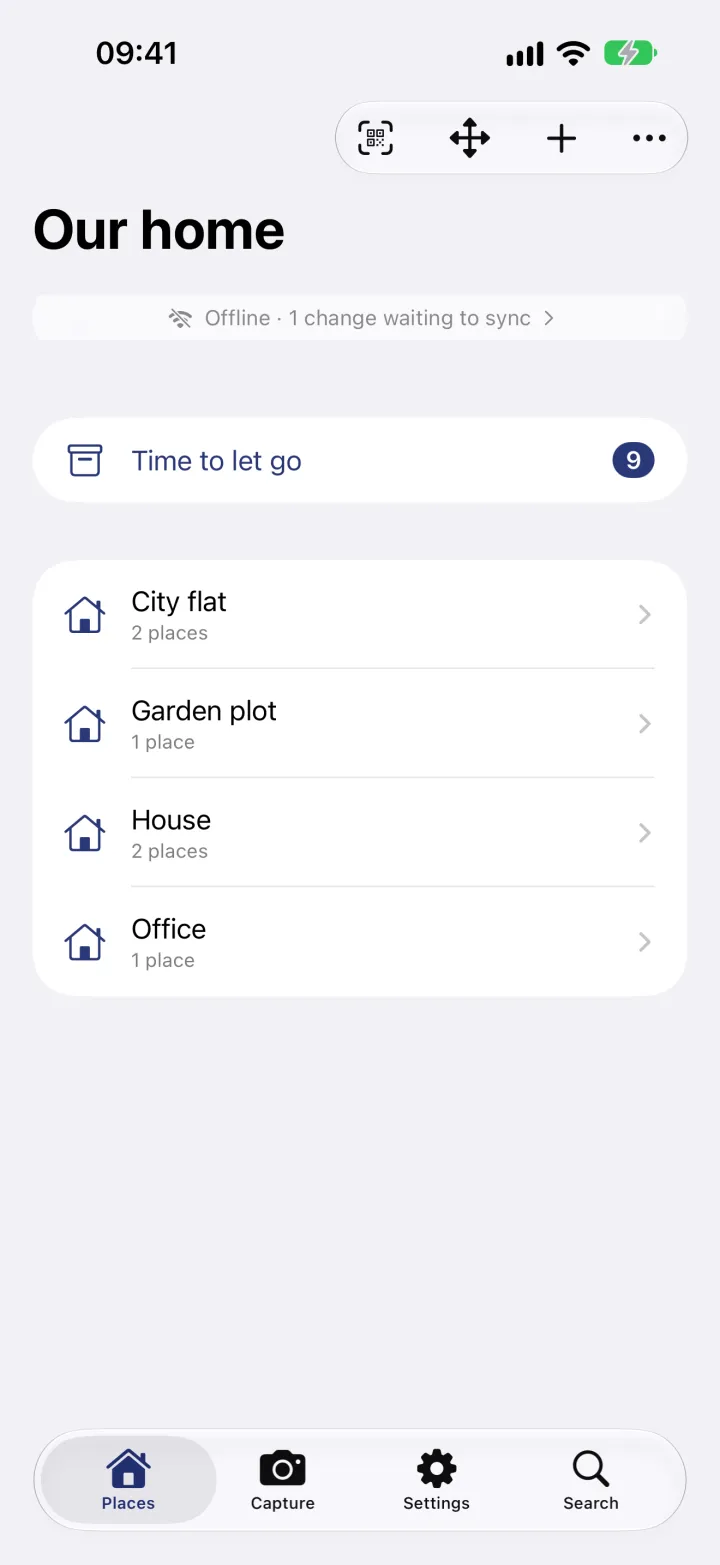
Neatkept for this
Storeroom with no signal
The storeroom is in the basement, and your phone has no signal down there. You're sorting the boxes anyway.
Print labels for your boxes
You've bought a stack of storage boxes and want each one to say what's inside without opening it.
Find anything in seconds
Your child needs the skis on Saturday, and you have a flat, a house and a garage. Ask once and know where to drive.
All your places
Every home you have, in one tree. Things sit in a box or right on a shelf, and each one has a full path.
Labels and box codes
A QR label or a code written with a marker. Either one opens the box in Neatkept.
Capture from a photo
Photograph an open box or a shelf. Neatkept lists what it sees, and you decide what to keep.
Search in your own words
Ask the way you'd ask a person. Neatkept answers with the home, the room, the box and a photo.
Works offline
Basements, garages and garden plots often have no signal. Neatkept works there anyway and catches up later.