 Neatkept
How to keep track of things across several homes
You live in the flat, spend weekends at the country house and keep a few things at the office. Half the time, what you need is in the other place.
Updated
Why things get lost between homes
With one home, a lost thing is somewhere in the flat. With two or three, it could be in any of them, and checking means a drive. Things go missing in the gaps: the drill taken to the country house for one job, the winter coats left at the flat, the projector borrowed from the office. Nobody decided they would live there. They just stayed.
The fix is not a better memory. It is a few plain decisions about where things belong, and a habit of noting the moment a thing changes home.
Give every thing a home base
Go through your things by kind, not by room, and give each kind one home base:
- Lives in one place. Garden tools at the country house, files at the office, the sewing machine at the flat. It may travel, but it always goes back.
- One in each place. Cheap things you need everywhere and every time: chargers, a hammer and screwdrivers, a first-aid kit, bedding, toiletries. Buying a second set costs less than the drives.
- Travels with you. The laptop, a camera, your own tools for work. These have no home base at all, so you note where you leave them.
Most arguments about "who took it" come from things that were never sorted into one of these.
Use the same structure in every home
Describe each home the same way, from big to small: the home, then the rooms, then the cupboards and shelves, then the boxes. Use the same names where you can. If the storeroom at the flat is "Storeroom" and the one at the house is "Storeroom" too, nobody has to learn a new map. What tells them apart is the home on top.
Number boxes so the code says nothing about the place: W01, W02. Then a box can move from the house to the flat without being relabelled. Write the code on two sides and the lid.
Note the moment a thing changes home
The one habit that matters: when you carry something to another home, note it before you leave, not when you arrive. At the door you still remember. Two days later, you don't.
A good travel note has three parts: what it is, where it came from, where it is now. When you're about to leave the other place, look at what came with you and decide: back home, or it lives here now. If it stays, change its home base, so the list is true again.
A checklist for each home
Keep these written down for every place you have:
- the address and how to get in: keys, gate and padlock codes, who holds a spare;
- the rooms and storage, with the boxes in each and what is in them;
- the things that live only here, so you don't buy them twice;
- what you brought from elsewhere and haven't taken back yet;
- what to do when you close the place for a season: water, heating, food, valuables.
With that, before any trip you can answer "is it there?" without phoning someone to go and look.
Doing it with Neatkept
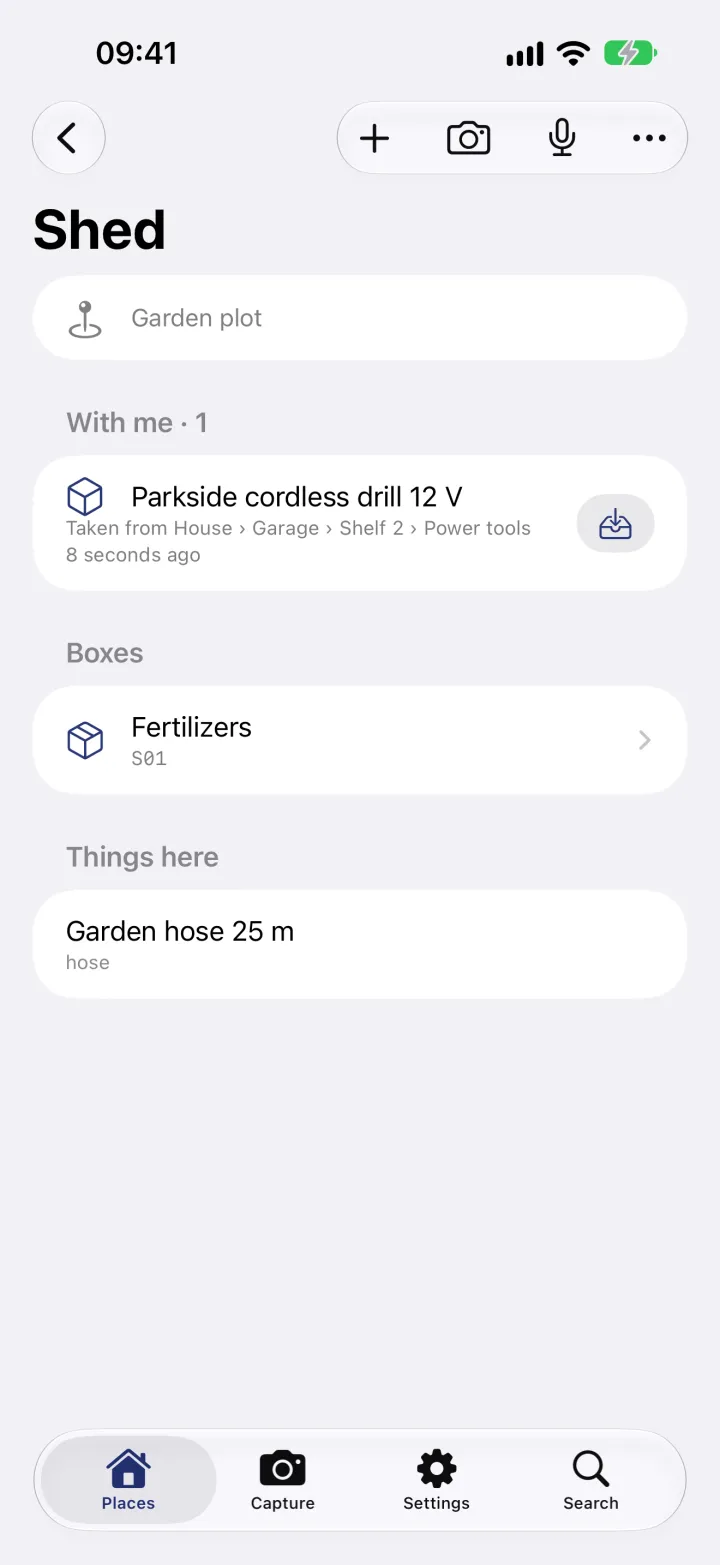
In Neatkept each home is a property in Places, with its own rooms, shelves and boxes, and one search covers all of them, so you see which home the skis are in before you go. A box or a thing moves to any place in any home in a few taps, with Undo. Swipe a thing all the way to take it with you: it shows where it came from until you put it back or put it down somewhere new. Tap "I'm here now" on a property, and the app opens it next time you arrive. The all your places and tools to the garden pages show how it works.
Questions and answers
Should I buy two of everything?
Only of cheap things you use in both places every time: chargers, a basic toolkit, toiletries, bedding. Expensive or rarely used things are better kept as one, with a clear home and a note when they travel.
How do I stop forgetting what I took to the other place?
Write it down when you take it, not when you arrive. A note with the thing and where it came from is enough. When you leave the other place, read the note and decide what goes back.
Is one list for all homes better than one per home?
One list. The question you ask is "where is it?", and you don't know the home yet. Group the list by home, but search it as one.
What about keys and gate codes for each place?
Keep them with the place they open, and somewhere only the people who need them can read. A code on a sticky note in the car is how other people learn it.
Neatkept for this
Tools to the garden
You need the drill at the garden plot this weekend. It lives in the house's garage, and next month someone will look for it there.
Seasonal swap
Winter is coming. The box with the ski clothes is in the house's attic, and you live in the city flat.
Find anything in seconds
Your child needs the skis on Saturday, and you have a flat, a house and a garage. Ask once and know where to drive.
All your places
Every home you have, in one tree. Things sit in a box or right on a shelf, and each one has a full path.
Moves
Tell Neatkept where a box or a thing went, and its place is right for everyone in your household.
With me
Take a thing along, and Neatkept knows it's with you. Later, put it back or put it where you are.
Search in your own words
Ask the way you'd ask a person. Neatkept answers with the home, the room, the box and a photo.