 Neatkept
How to stop buying what you already have: telling spare copies from accidental duplicates
A second blender, a fourth tape measure, a shirt you found "lost in the back". Some copies are sensible and some are an accident, and a list tells them apart.
Updated
The problem is rarely the shop
Most people don't buy a second drill because they love drills. They buy it because the first one is in the garage, or in a box at the cabin, or lent to a neighbour, and standing in a shop with a bad memory the cheapest answer is to buy another. A duplicate is usually a finding problem wearing a shopping problem's clothes.
So the cure is not willpower at the till. It is being able to answer "do I have one, and where?" in a few seconds, before you pay.
Two kinds of duplicates
Not every second copy is a mistake, and treating them all as clutter makes people stop listening. Sort them into two groups.
Copies on purpose. There is a reason, and you could say it out loud:
- a mop and bucket on each floor, so nobody carries one up the stairs;
- painkillers, plasters and a torch in every room that needs them;
- coats and boots for each kind of weather, and for each person;
- the same tool at the cabin and at home, so you don't carry it back and forth;
- a spare of something that would ruin a day if it broke, like a bicycle pump or a phone charger.
Copies by accident. Nobody chose them:
- two blenders in one kitchen, because one was hidden behind the pans;
- the fifth tape measure, bought on the day you needed one;
- the shirt you bought again after it was "lost in the back" of a wardrobe, then found;
- a second set of hex keys, bought for a job, never put in the toolbox afterwards.
The line between the two is a personal one. One person's sensible spare is another's clutter, and you don't need to agree with anyone else. You only need to know which of your copies are which.
Why a list is what tells them apart
Seeing the difference needs one thing: knowing where every copy is. Two drills in the same toolbox are almost certainly accidental. One drill at home and one at the cabin is a pair. A ladder in the garage and another in the attic is a question worth asking.
Without a list you can't see any of that, because the second copy is, by definition, in a place you forgot about. With one, the copies line up next to each other and the answer is usually obvious.
Build the list from what you already own
You don't need a full inventory to start. Begin with the things people buy twice most often:
- Tools: tape measures, drills, screwdriver and hex key sets, spirit levels, clamps;
- Kitchen gadgets: blenders, hand mixers, graters, waffle irons;
- Cables and chargers: one drawer, emptied on the table, is enough;
- Sports and camping gear: tents, sleeping bags, helmets, pumps;
- Clothes you buy by habit: black jumpers, white shirts, rain jackets.
For each, write the name, how many you have, and where. A line like "Tape measure, 3: toolbox, kitchen drawer, car" is enough. If a thing has a barcode, write that down too, since it is the surest way to recognise the same product later.
Do it room by room and don't try to finish in a day. A list that covers the garage and the kitchen drawer already catches most of the doubles.
Check before you buy
Make one habit: before buying anything that lasts, spend a minute on the list. Look it up by what it does as well as by its name. "Something to cut tiles" should also find the tile cutter you bought for the bathroom.
If the answer is yes, ask whether you want the one you have: does it work, is it in reach, is it the right size? Often the fix is to bring the old one to where you need it. If the answer is really no, buy it, and add it to the list when you get home so the next check is correct.
Deal with the doubles you find
When the list shows accidental duplicates, decide quickly. Keep the best one, in the place where you will actually use it. Sell, give away or donate the rest, and do it within a week, because a "spare" kept for later is just the next thing to forget. Copies kept on purpose stay, and it helps to say why in a few words next to them.
Doing it with Neatkept
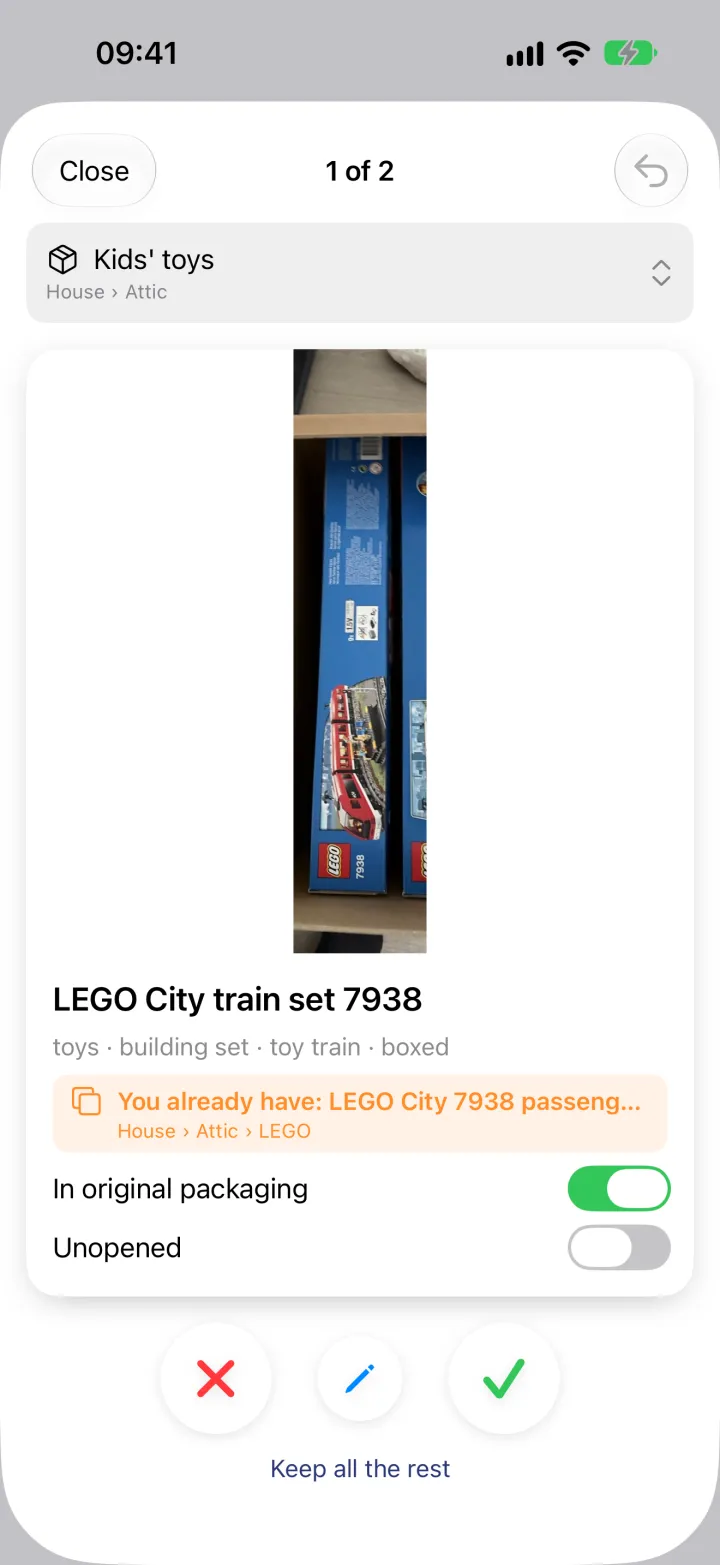
In Neatkept the list builds from photos: photograph an open box or a shelf and the AI proposes what it sees, and you keep or drop each thing with a tap. When a proposed thing matches something you already own, its card says "You already have:" with the name and the place, and you decide whether the second copy is worth keeping.
In a shop, open Search, type what you're about to buy and tap "Do I have … already?", or scan the product's barcode to see things saved with that code. Neatkept matches barcodes first, then similar names, and has an AI model judge each pair. If the AI is off or can't be reached, only barcodes count, so you don't get look-alikes that are really something else. The do I have it already page shows how it works, and declutter helps with the copies you decide to let go.
Questions and answers
Is it wrong to own two of the same thing?
No. A mop on each floor or painkillers in every room is a decision, not clutter. The trouble starts with copies nobody chose, like two blenders in one kitchen. The test is whether you can say why there are two.
How many tape measures or screwdriver sets are too many?
There is no number. Ask whether each copy is in a place where you actually reach for it. One in the toolbox and one in the kitchen drawer works. Three in the same toolbox means you couldn't find the first two.
What do I do with the extra copies I find?
Keep the best one, then sell, give away or donate the rest, ideally the same week. Spare copies kept "in case" tend to turn into the next box of things nobody has looked at.
Does it work for things I buy often, like batteries or light bulbs?
Partly. For things you use up, a quick look at the shelf before shopping is enough. A list helps most for things that last for years: tools, appliances, sports gear, cables.
Neatkept for this
Do I have it already?
You're in a shop holding a LEGO train and can't remember whether the kids already have it. Or it's a gift, and you're putting it away.
Declutter
The closets are full of things bought years ago. You'd let some of them go, if you knew which.
You may have this already
Before you buy or save a second drill, Neatkept tells you about the first one and where it is.
Search in your own words
Ask the way you'd ask a person. Neatkept answers with the home, the room, the box and a photo.
Barcodes and packaging
Scan the barcode of a thing in its box, or photograph the packaging. Neatkept fills in the name for you.
Declutter
Set a rule like "not touched for 2 years", and Neatkept shows what's due. You decide, one card at a time.